


The 10-year Treasury yield closed at its highest level since 2002. Here's what that means for borrowers
The yield on the 10-year U.S. Treasury note closed at 5.31% on 5 October, according to the Treasury Department's daily data. That is its highest close since 5.32% on 14 May 2002 [1]. Mortgage rates have risen with it: Freddie Mac's 30-year average reached 7.40% in the week to 8 October, up from 6.30% a year earlier [4]. Federal interest costs have also climbed. Net interest reached $1.017 trillion in fiscal 2026 through August, more than the government spent on national defense, according to the Monthly Treasury Statement [16]. Fed Governor Christopher Waller has attributed the rise in yields to growth expectations, fiscal concerns and heavy AI-related borrowing rather than higher inflation expectations, in remarks on 13 October [8][9]. The yield has since eased, to 5.21% at the 13 October close, the latest in Treasury's data [1].
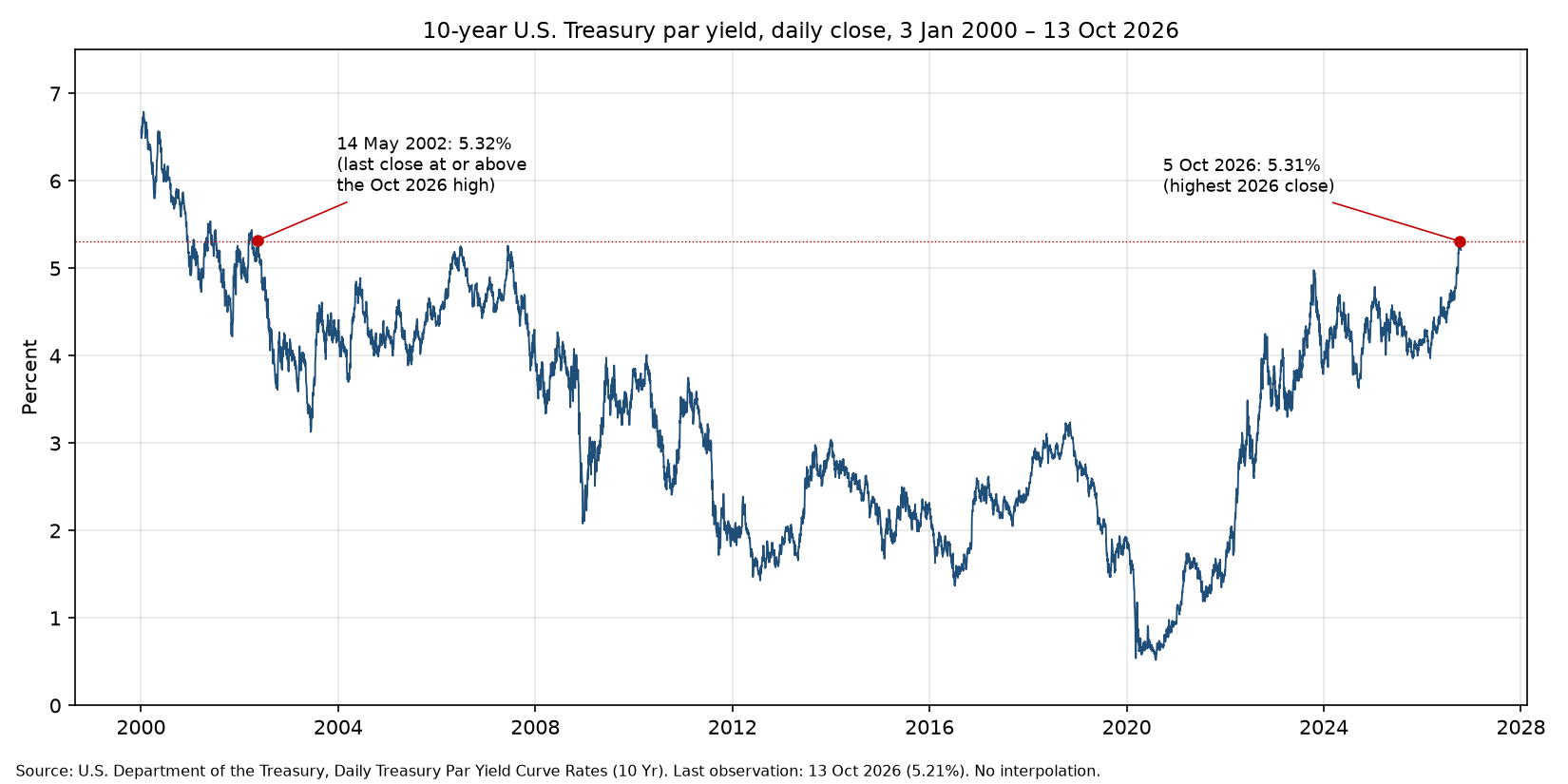
Chart: The 10-year Treasury par yield at each daily close, from 3 January 2000 to 13 October 2026. The red points mark the highest close of 2026 (5.31% on 5 October) and 14 May 2002 (5.32%), the last close at or above that level. Data: U.S. Treasury Department daily par yield curve rates [1]. The line ends at the last published observation, 13 October 2026. No values are interpolated.
How high, and when
On Treasury's official end-of-day data, the 10-year closed at 5.29% on 30 September and 5.24% on 1 October. It reached 5.31% on 5 October, then closed at 5.27% and 5.28% on 6 and 7 October [1]. The last close at or above 5.31% was 5.32% on 14 May 2002 [1]. Dow Jones Market Data, using 3 p.m. ET Tradeweb values, also put the 52-week high at 5.310% on 5 October [5].
Intraday readings went higher than the closes. On 1 October, Reuters reported that the yield rose as high as 5.342% before the U.S. market opened. It closed that day at 5.24%, per Treasury [1][2]. CNBC also reported on the rise that day [3].
The yield has since eased. It closed at 5.21% on Tuesday, 13 October, per Treasury; that is the latest close in Treasury's daily data as of early 14 October [1]. Dow Jones reported a 3 p.m. ET reading of 5.216%, the lowest since 25 September [5]. Dow Jones said the yield was down 0.077 percentage point for the month and up 1.064 points for the year, from a 2026 closing low of 3.961% on 27 February [5]. CNBC attributed Tuesday's decline to lower energy prices [6].
Real yields. In a 2 October note, BNY Investments said "the recent increase has been driven mainly by real yields." It said 10-year real yields had reached 2.90%, "their highest level since 2008," while the 10-year inflation breakeven held around 2.35% [19]. Treasury's daily real yield curve shows the 10-year real yield at 2.90% on 28 September, 2.95% on 5 October and 2.88% on 13 October [20].
Outside views. Apollo's Daily Spark note of 13 October (data as of 30 September), published under chief economist Torsten Slok and written by Allison Boxer, said 10-year yields had risen by about 100 basis points since the start of the year. It attributed the move to "both the higher expected policy path from the Fed and investors asking for more compensation to hold duration" [21]. U.S. Bank's October economic outlook, from a team led by chief economist Beth Ann Bovino, said the yield's climb above 5.30% reflected "a growing reassessment of both the economic outlook and the trajectory of monetary policy" [22].
What it means for borrowers
The 10-year yield is a benchmark for many longer-term loans, so its rise has shown up in what households, companies and the government pay.
Mortgages. Freddie Mac's Primary Mortgage Market Survey put the average 30-year fixed rate at 7.40% for the week ending 8 October, up from 7.28% a week earlier and 6.30% a year earlier [4]. The 15-year average was 6.73% [4]. FRED's copy of the series shows the 30-year average rising every week since early September: 6.76% (10 Sept), 6.95% (17 Sept), 7.03% (24 Sept), 7.28% (1 Oct) and 7.40% (8 Oct) [7]. Mortgage News Daily's daily index, which moves faster than Freddie Mac's weekly survey, put the 30-year fixed at 7.46% on 13 October. That was down 0.02 point on the day, against a 52-week range of 5.99% to 7.61%, according to MND's index pages [23]. MND's 13 October rate report called it a two-week low [17].
"In 2023, when the 10yr Treasury yield hit 5%, we saw a solid show of support from buyers. In 2026, we've been waiting to see a similar show of support as yields crested 5.3%. Last week brought the first potential evidence of such support," Matthew Graham of Mortgage News Daily wrote on 13 October [17]. He added that if Wednesday's inflation data come in higher than expected, "yields/rates could move back up toward recent highs" [17]. Freddie Mac's next survey is due Thursday, 15 October [7].
Car loans and credit cards. These rates are set more by short-term rates and lenders' risk pricing than by the 10-year yield. The Federal Reserve's G.19 consumer credit release of 7 October reported these average commercial-bank rates in the third-quarter survey [10]:
- 60-month new-car loans: 7.54%, up from 7.14% in the second quarter;
- 72-month new-car loans: 7.17%, up from 6.97%;
- credit cards, all accounts: 21.19%;
- credit card accounts assessed interest: 22.36%.
The Fed surveys these rates in the first week of the middle month of each quarter, so they predate the October yield peak [10].
The federal government. The Treasury is itself a borrower. Its Monthly Treasury Statement shows net interest outlays of $1.017 trillion ($1,016,966 million) in fiscal 2026 through 31 August [16]. Outlays for national defense over the same 11 months were $876 billion [16]. Gross interest on Treasury debt securities, which includes interest credited to federal trust funds, was about $1.27 trillion over the same period, per the statement [16]. The Congressional Budget Office estimated on 9 September that the deficit for the first 11 months of the fiscal year was $2.0 trillion, $6 billion less than a year earlier. It said that without shifts in the timing of certain payments, the deficit would have been $82 billion larger than the year before [18]. Net interest for the full fiscal year rose $115 billion, or 11%, "because the debt was larger and long-term interest rates were higher," according to an American Action Forum analysis of CBO's September review, published 8 October [26].
Business borrowing. Asset managers and Reuters report heavy AI-related bond issuance. Amundi's CPR AM estimated on 23 September that hyperscalers had issued about $223 billion in bonds so far in 2026, about $117 billion more than in all of 2025 [11]. Capital Group said on 1 October that U.S. investment-grade corporate spreads ended August at 78 basis points, unchanged for the year, while spreads on long-dated hyperscaler and other AI-related bonds had widened [12]. Reuters reported on 22 September, in figures Groksinews has not independently verified, that the high-grade market had "split in two." AI-related bonds were being met with caution while traditional issuers drew strong demand [13]. Reuters also cited Goldman Sachs data projecting hyperscaler gross issuance of a record $420 billion in 2027 [13]. PIMCO, in a 28 September note using data as of 23 September, said it saw "no sign of crowding out" in pricing for non-AI borrowers [14].
The Fed's position
At its 15ΓÇô16 September meeting, the Federal Open Market Committee voted 12ΓÇô0 to raise the federal funds target range by a quarter point to 3┬╛ to 4 percent [15]. "Inflation remains elevated," the statement said, adding that "the Committee will deliver price stability" [15]. The Fed sets short-term rates directly. Longer-term yields such as the 10-year are set in the bond market.
Waller: growth, debt and AI, not inflation fears
Waller spoke on 13 October in a moderated conversation with Bloomberg's Saleha Mohsin at the Bloomberg New Economy Forum in New Delhi, according to Bloomberg's own Bloomberg Talks podcast episode of 13 October [27]. Scotsman Guide and a third-party transcript of the event video report the same setting [9][24]. Reuters reported via U.S. News that he said U.S. inflation expectations are well anchored [8].
"It's not yields have gone up because there is expected higher future inflation," Waller said, according to the transcript. "Inflation expectations are well anchored" [24]. He pointed instead to "real growth," "general fiscal concerns around the world" and competition for funds from the AI build-out [24]. "I've long argued that the ten year rate is determined by global supply and demand," he said [24].
On Treasurys' safe-haven status, he said "there's a lot of academic research coming out in the U.S. that that safety liquidity premium on U.S. treasuries is gone. It's gone," according to an excerpt from the CEOInterviews.AI third-party transcript [24]. The transcript's summary puts the cost at 50 to 70 basis points [24], the same range Scotsman Guide reported [9]. On 3 September, at a Reuters NEXT Newsmaker event, Waller had made a similar argument: "There's no more premium for safe, liquid U.S. government debt," which he said was leading him to raise his estimate of the neutral rate, Reuters reported [25]. Asked how long AI-related demand pressure could last, he said it "could last anywhere from 2 to 3 years, given how much they've committed already to spend out in the future" [24].
ANALYSIS: Waller's explanation matters for borrowers because of where it points. If yields are rising on growth, fiscal supply and AI debt rather than inflation fears, Fed rate moves alone may do little to lower long-term borrowing costs. Mortgage rates track the 10-year more closely than the fed funds rate, so they would depend largely on bond-market supply and demand. The same dynamic feeds back into the budget: higher yields raise the cost of new Treasury borrowing, adding to an interest bill that already exceeds defense spending.
Sources
[1] U.S. Department of the Treasury, Daily Treasury Par Yield Curve Rates, 2000ΓÇô2026 (10 Yr column), downloaded 14 Oct 2026; latest observation 13 Oct 2026. https://home.treasury.gov/resource-center/data-chart-center/interest-rates/TextView?type=daily_treasury_yield_curve [2] Reuters, "10-year US Treasury yield hits highest since 2002," 1 Oct 2026. https://www.reuters.com/world/10-year-us-treasury-yield-hits-highest-since-2002-2026-10-01/ [3] CNBC, Treasury yields, 1 Oct 2026. https://www.cnbc.com/2026/10/01/us-treasury-bond-yield.html [4] Freddie Mac, Primary Mortgage Market Survey, results as of 8 Oct 2026. https://www.freddiemac.com/pmms [5] Dow Jones Market Data via Morningstar, "10-Year Treasury Yield Falls to 5.216% ΓÇö Data Talk," 13 Oct 2026. https://www.morningstar.com/news/dow-jones/202610137666/10-year-treasury-yield-falls-to-5216-data-talk [6] CNBC, "U.S. Treasury yields fall as energy prices pull back," 13 Oct 2026. https://www.cnbc.com/2026/10/13/us-treasurys-bonds-yields.html [7] FRED, Federal Reserve Bank of St. Louis, 30-Year Fixed Rate Mortgage Average (MORTGAGE30US), source Freddie Mac, updated 8 Oct 2026. https://fred.stlouisfed.org/series/MORTGAGE30US [8] U.S. News / Reuters, "US inflation expectations are well anchored, Fed's Waller says," 13 Oct 2026. https://money.usnews.com/investing/news/articles/2026-10-13/us-inflation-expectations-are-well-anchored-feds-waller-says [9] Scotsman Guide, "Fed's Waller believes AI-fueled inflation could persist for years" (report on Waller's Bloomberg New Economy Forum appearance), Oct 2026. https://www.scotsmanguide.com/news/feds-waller-says-ai-fueled-inflation-could-persist-for-years/ [10] Board of Governors of the Federal Reserve System, G.19 Consumer Credit, release of 7 Oct 2026. https://www.federalreserve.gov/releases/g19/20261007/ [11] CPR AM (Amundi), Do Ake and Bastien Drut, "What impact is hyperscaler bond issuance having on bond markets?" 23 Sep 2026. https://cpram.com/cze/en/individual/publications/experts/article/what-impact-is-hyperscaler-bond-issuance-having-on-bond-markets [12] Capital Group, "The AI debt boom: Balancing risk and opportunity," 1 Oct 2026. https://www.capitalgroup.com/pcs/insights/articles/ai-debt-boom-balancing-risk-opportunity.html [13] Reuters, "Corporate bond buyers get picky with flood of AI debt," 22 Sep 2026. https://www.reuters.com/legal/transactional/corporate-bond-buyers-get-picky-with-flood-ai-debt-2026-09-22/ [14] PIMCO, "The Credit Market Lens: Hyperscalers Are Repricing, Not Displacing (So Far)," Lotfi Karoui, 28 Sep 2026 (data as of 23 Sep 2026). https://www.pimco.com/us/en/insights/the-credit-market-lens-hyperscalers-are-repricing-not-displacing-so-far [15] Board of Governors of the Federal Reserve System, "Federal Reserve issues FOMC statement," 16 Sep 2026. https://www.federalreserve.gov/newsevents/pressreleases/monetary20260916a.htm [16] U.S. Department of the Treasury, Bureau of the Fiscal Service, Monthly Treasury Statement for fiscal year 2026 through 31 August 2026 (PDF; net interest $1,016,966M, national defense $876,163M, gross interest on Treasury debt securities $1,267,362M). https://fiscaldata.treasury.gov/static-data/published-reports/mts/MonthlyTreasuryStatement_202608.pdf [17] Mortgage News Daily, "Mortgage Rates Inch to Another 2-Week Low," Matthew Graham, 13 Oct 2026. https://www.mortgagenewsdaily.com/markets/mortgage-rates-10132026 [18] Congressional Budget Office, "Monthly Budget Review: August 2026," 9 Sep 2026. https://www.cbo.gov/publication/61984 [19] BNY Investments, "Treasury Yields Push to Multi-Decade Highs, and History Says They May Climb Further," institutional note, 2 Oct 2026. https://www.bny.com/investments/us/en/institutional/articles/markets-and-economy/treasury-yields-push-to-multi-decade-highs--and-history-says-the.html [20] U.S. Department of the Treasury, Daily Treasury Par Real Yield Curve Rates, SeptemberΓÇôOctober 2026. https://home.treasury.gov/resource-center/data-chart-center/interest-rates/TextView?type=daily_treasury_real_yield_curve&field_tdr_date_value_month=202610 [21] Apollo, The Daily Spark, "Decomposing the Move Higher in 10-Year Rates," Torsten Slok (written by Allison Boxer), 13 Oct 2026. https://www.apollo.com/wealth/insights-news/insights/daily-spark/decomposing-the-move-higher-in-10-year-rates [22] U.S. Bank, October 2026 Economic Outlook (Beth Ann Bovino et al.). https://www.usbank.com/content/dam/usbank/en/documents/pdfs/corporate-and-commercial-banking/october-26-economics.pdf [23] Mortgage News Daily, 30-year fixed rate index, 13 Oct 2026. https://www.mortgagenewsdaily.com/mortgage-rates/30-year-fixed [24] CEOInterviews.AI, "Fed's Waller on Monetary Policy in the Age of AI" (transcript of Bloomberg Live video, Bloomberg New Economy Forum, New Delhi), 13 Oct 2026. https://ceointerviews.ai/interview/3049573/ [25] Reuters (David Lawder, Howard Schneider), "Fed's Waller says safety premium for Treasuries is gone, pushing neutral rate higher," 3 Sep 2026. https://www.reuters.com/business/feds-waller-says-safety-premium-treasuries-is-gone-pushing-neutral-rate-higher-2026-09-03/ ; syndicated copies: https://finance.yahoo.com/economy/policy/articles/feds-waller-says-safety-premium-174613429.html ; https://www.investing.com/news/economy-news/feds-waller-says-safety-premium-for-treasuries-is-gone-pushing-neutral-rate-higher-4888374 [26] American Action Forum, "CBO: FY 2026 Budget Deficit Totaled $2 Trillion," 8 Oct 2026. https://www.americanactionforum.org/insight/cbo-fy-2026-budget-deficit-totaled-2-trillion/ [27] Bloomberg Talks (podcast), "Fed's Christopher Waller Talks Higher Yields, Inflation," 13 Oct 2026 (transcript via Audioscrape). https://audioscrape.com/podcast/bloomberg-talks/episode/feds-christopher-waller-talks-higher-yields-inflation-3391

