Study finds nearby galaxies have less central dark matter
A Nature Astronomy study of 136 nearby galaxies finds less dark matter in their centers than several widely used simulations predict.
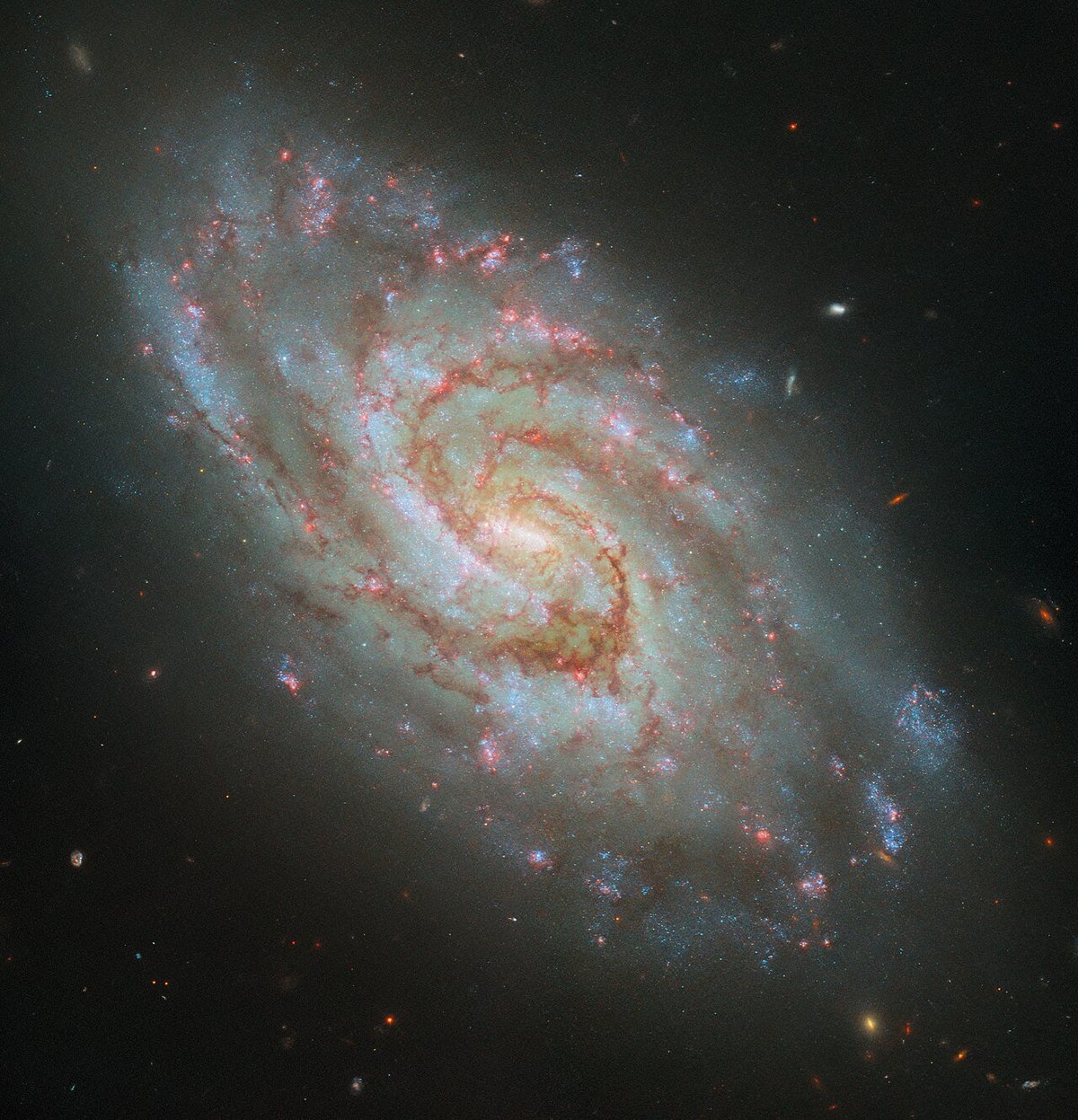
This image is believed to be available for open use. Credit: ESA/Hubble & NASA, D. Thilker, J. Lee and the PHANGS-HST Team / Wikimedia Commons. If you are the rights holder and object, contact us and we'll remove it.
As of 3:39 p.m. ET, Friday, Nov. 27, 2026
A study of 136 nearby galaxies, published Thursday, Nov. 26, 2026, in Nature Astronomy, finds that the galaxies' inner regions contain less dark matter than several widely used cosmological simulations predict.
The paper, "Lower central dark matter densities in nearby galaxies than predicted by simulations," was led by Yu Lei of the Shanghai Astronomical Observatory of the Chinese Academy of Sciences. Researchers at the Instituto de Astrofísica de Canarias, or IAC, were part of the team. The IAC announced the work on Nov. 26, 2026. The Chinese Academy of Sciences also issued an account of the study, saying it was published in Nature Astronomy on Nov. 26.
The paper's abstract says: "Here we consistently measure the DM distribution from galaxy centres out to radii of 20–50 kpc for 136 nearby galaxies that together span the local mass–size relation over the stellar mass interval 10^9–10^11.5 M⊙." The IAC and the Chinese Academy of Sciences described that mass range as approximately one billion to 300 billion times the mass of the Sun.
"The stars and the gas give us complementary views of a galaxy's gravitational pull. By bringing them together, we can trace its dark matter much farther out and test whether the galaxies in our simulations resemble those we actually observe," Lei said, according to the IAC and the Chinese Academy of Sciences.
The IAC said the team combined stellar-motion measurements from the MaNGA and CALIFA surveys with radio observations of neutral hydrogen, including data from China's Five-hundred-meter Aperture Spherical radio Telescope, or FAST, and that those observations were used to trace the gravitational field from galaxy centers to their outskirts.
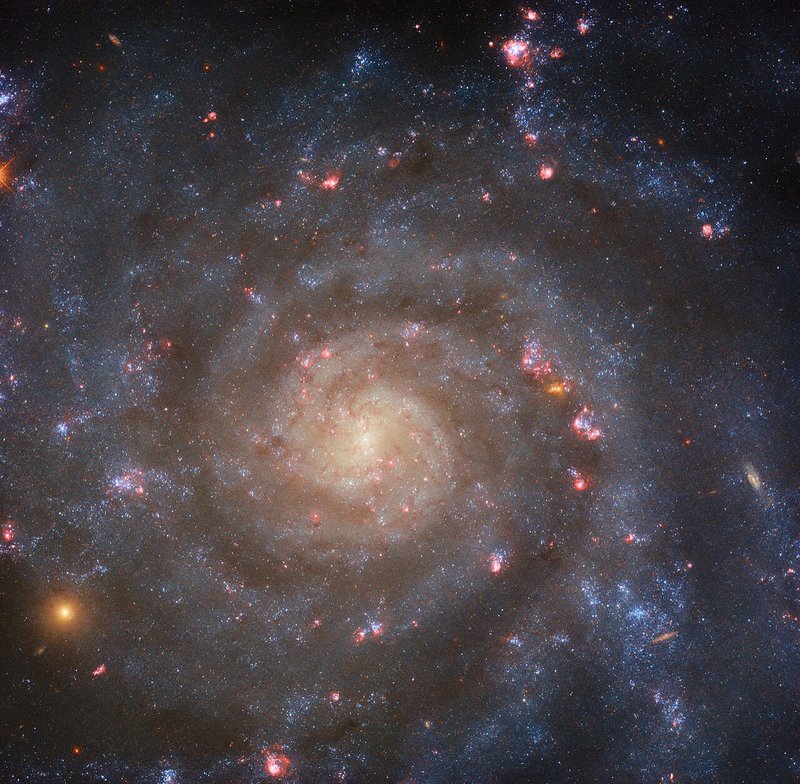
This image is believed to be available for open use. Credit: ESA/Hubble & NASA, R. Chandar, J. Lee and the PHANGS-HST team / Wikimedia Commons. If you are the rights holder and object, contact us and we'll remove it.
The abstract says the team identified "central regions with lower DM densities relative to Λ cold dark matter simulation expectations," and that the extent of those regions grows from about 10 kiloparsecs to more than 50 kiloparsecs as stellar mass increases from 10^10 to 10^11 solar masses. The IAC and the Chinese Academy of Sciences said the mismatch appears in galaxies with stellar masses above about 10 billion solar masses, when compared with the IllustrisTNG, EAGLE and SIMBA simulations, and that a distance of about 50 kiloparsecs is equivalent to about 160,000 light-years.
"What makes this result particularly interesting is how far the discrepancy extends. Our measurements give simulations a demanding test: they must reproduce both the visible galaxy and the distribution of dark matter revealed by the motions of its stars and gas," IAC researcher Jesús Falcón-Barroso, a co-author, said, according to the IAC.
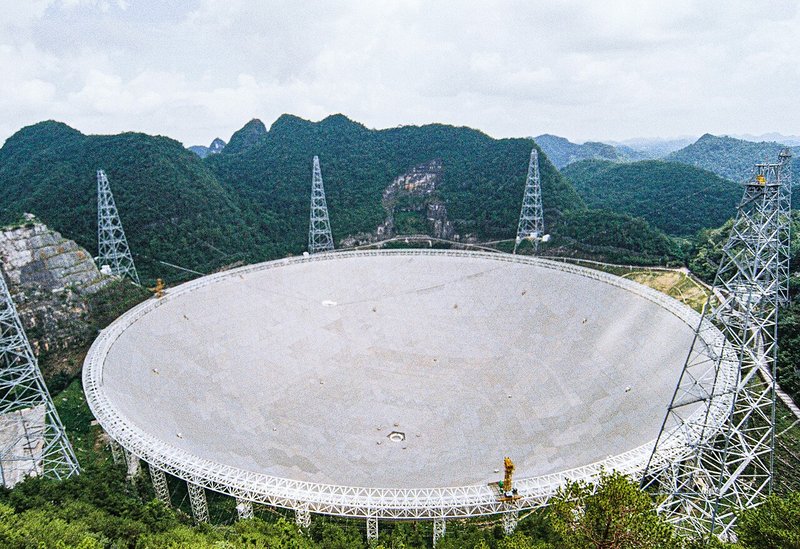
This image is believed to be available for open use. Credit: SCJiang / Wikimedia Commons. If you are the rights holder and object, contact us and we'll remove it.
The abstract says, "Although their physical origin remains unclear, these low-dark-matter regions are clearly indicated by the data." The IAC said many simulations predict that, as stars and gas accumulate toward a galaxy's center, their gravity draws dark matter inward and increases its density, and that the new observations suggest the balance between processes that concentrate dark matter and those that redistribute it is still not fully captured. The IAC said possible explanations include energy released as matter falls toward supermassive black holes, or dark-matter particles interacting with one another, and that simulations incorporating such interactions reproduce some of the observed trends but still do not match the measurements quantitatively.
The IAC said the findings "provide a new challenge for galaxy formation models, while leaving the underlying nature of dark matter unresolved."
| Item | As stated |
|---|---|
| Galaxies in the sample | 136 nearby galaxies |
| Stellar-mass range | 10^9 to 10^11.5 solar masses, or about 1 billion to 300 billion times the mass of the Sun |
| Radii measured | From galaxy centers out to 20–50 kiloparsecs |
| Where the discrepancy appears | Galaxies above about 10 billion solar masses |
| How far the discrepancy extends | About 10 kiloparsecs to more than 50 kiloparsecs as stellar mass rises from 10^10 to 10^11 solar masses |
| 50 kiloparsecs, as converted by the IAC and CAS | About 160,000 light-years |
| Simulations named in the comparison | IllustrisTNG, EAGLE and SIMBA |
Table: GROKsiNEWS.com. Source: Abstract of Lei et al., Nature Astronomy, published Nov. 26, 2026; IAC release, Nov. 26, 2026; Chinese Academy of Sciences account.
Sources
- Yu Lei et al., "Lower central dark matter densities in nearby galaxies than predicted by simulations," Nature Astronomy, published Nov. 26, 2026
- Instituto de Astrofísica de Canarias, "The dark matter puzzle deepens: nearby galaxies challenge cosmic simulations," advertised Nov. 26, 2026
- Chinese Academy of Sciences, "Dark Matter Puzzle Deepens: Nearby Galaxies Challenge Cosmic Simulations"
- Wikimedia Commons, ESA/Hubble & NASA, Hubble image of IC 1954, released Sept. 23, 2024
- Wikimedia Commons upload file, same Hubble image of IC 1954
- Wikimedia Commons, ESA/Hubble & NASA, Hubble image of IC 5332, released Oct. 16, 2023
- Wikimedia Commons upload file, same Hubble image of IC 5332
- Wikimedia Commons, SCJiang, FAST radio telescope, Aug. 10, 2025
- Wikimedia Commons upload file, same FAST photograph
- Live GROKsiNEWS.com, ESA Antarctic subglacial lakes
- Live GROKsiNEWS.com, Webb observations of 3I/ATLAS ice grains