Spain votes Sunday in snap election focused on housing
Spain holds a snap general election on Sunday, Nov. 29, 2026, under Royal Decree 806/2026 of Oct. 5, published in the Official State Gazette on Oct. 6, which dissolved the Congress of Deputies and the Senate elected on July 23, 2023, and set the vote for that Sunday. All 350 seats in the Congress of Deputies are being elected; 176 seats are required for a majority. In a televised debate on Thursday night, Nov. 26, the main party leaders clashed over housing, BBC News reported. Alberto Núñez Feijóo of the People's Party (PP) told viewers he would build a million new homes, BBC News reported, and, having called access to housing a "vital emergency," he wants to cut taxes for people under 40 buying a first home and scrap the Socialists' housing law. Prime Minister Pedro Sánchez "talked up his recent emergency measures designed to protect tenants and cap rents," BBC News reported; Reuters said Sánchez has been in favor of rent caps and short-lease bans. Santiago Abascal, the leader of Vox, "told the debate only he cared about those who had the greatest housing need," BBC News reported; BBC News also said Vox has promised to prioritize Spaniards over foreigners for social housing and housing aid. Ada Colau, who heads the Broad Front, "said taxing rich and exploitative landlords was urgently required," BBC News reported. The official CIS pre-election survey, study 3584, conducted Oct. 7–30, 2026, among 45,074 people and released Nov. 12, estimated the Socialists (PSOE) at 33.3 percent of the valid vote (134–143 seats), the PP at 25.5 percent (98–106) and Vox at 18.4 percent (57–65). Reuters and BBC News, citing other polls, have described the PP as narrowly ahead.
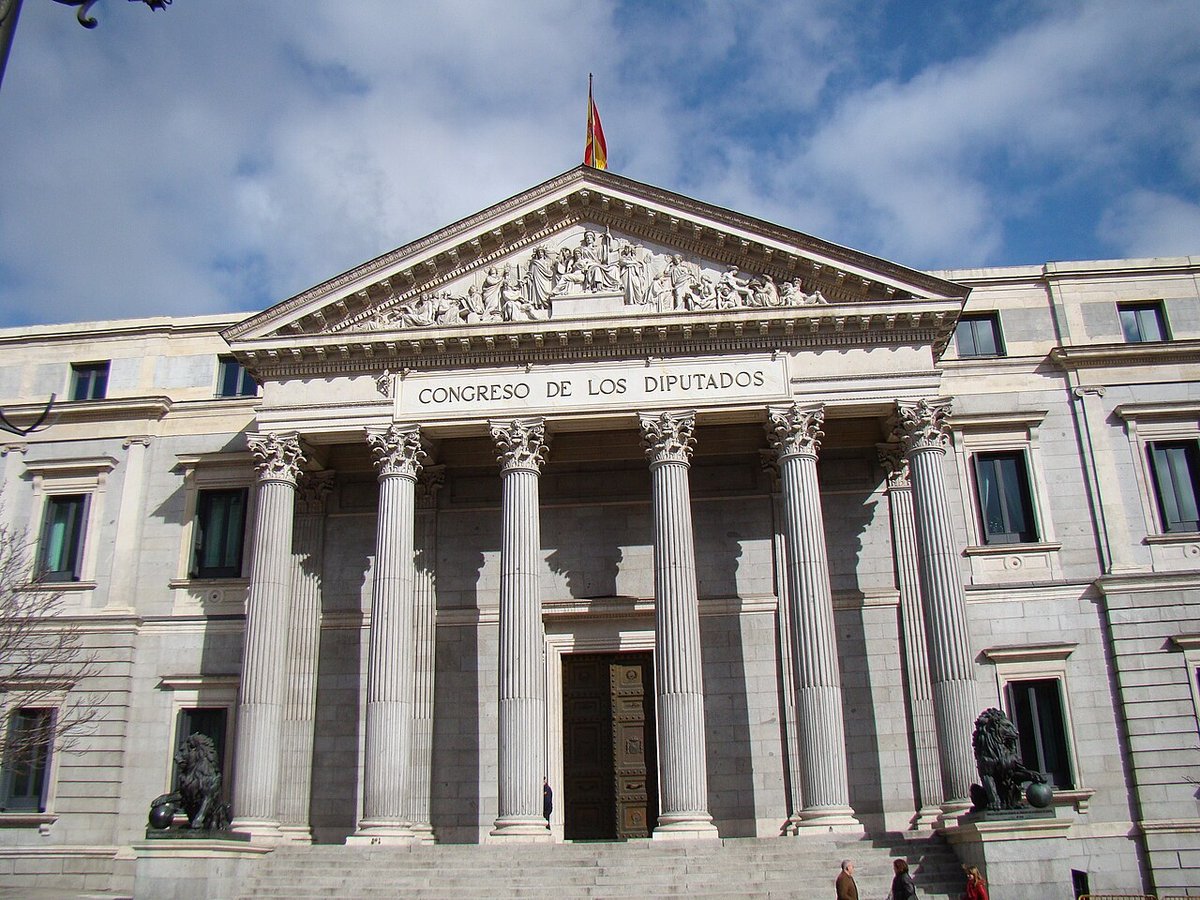
This image is believed to be available for open use. Credit: Antonio.velez / Wikimedia Commons. If you are the rights holder and object, contact us and we'll remove it.
As of 11:10 a.m. ET, Friday, Nov. 27, 2026
Spain holds a snap general election on Sunday, Nov. 29, 2026. Royal Decree 806/2026 of Oct. 5, issued by King Felipe and the prime minister, Pedro Sánchez, and published in the Official State Gazette on Oct. 6, dissolved the Congress of Deputies and the Senate elected on July 23, 2023, and called elections to both chambers for that Sunday. The decree's annex assigns deputies among 52 constituencies totaling 350 seats. A majority in the Congress of Deputies is 176 seats. Only the lower house chooses the prime minister, Reuters reported.
Polling stations are scheduled to open at 9 a.m. local time Sunday (3 a.m. ET) and close at 8 p.m. local time (2 p.m. ET), BBC News and Al Jazeera reported. Spain observes Central European Time (UTC+1) on these dates, six hours ahead of Eastern Time (UTC-5). The election campaign ran from the start of Friday, Nov. 13, to midnight Friday, Nov. 27, local time (6 p.m. ET Friday), the decree said. The new chambers are to hold their constituent sessions at 10 a.m. on Dec. 23, the decree said. Reuters reported that the new lower house will meet that day and elect a speaker, and that King Felipe will then nominate a candidate for the premiership, usually the leader of the party with the most votes.
Sánchez called the early vote after parliament on Oct. 2 rejected decrees he had proposed to address anger over rising rents and evictions, Reuters reported. Reuters said the immediate backdrop included protests after the eviction, and later death, of 87-year-old Maricarmen Abascal, after the monthly rent on her longtime home in Madrid was raised to 1,650 euros from 570 euros. BBC News said a revised version was later pushed through a parliamentary standing committee, restricting evictions and capping rent rises. GROKsiNEWS.com previously reported a nationwide general strike over housing on Nov. 11.
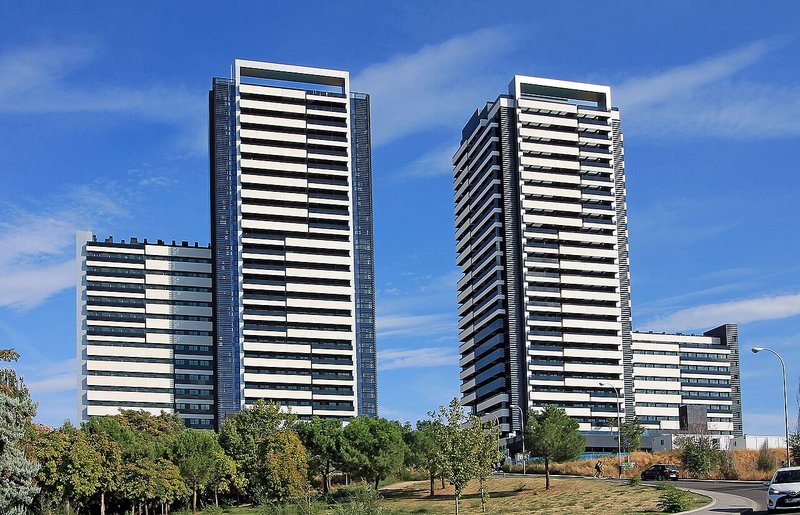
This image is believed to be available for open use. Credit: Luis García / Wikimedia Commons. If you are the rights holder and object, contact us and we'll remove it.
In the final televised debate on Thursday night, Nov. 26, housing dominated, BBC News's Nick Beake reported from Valencia. Feijóo told viewers he would build a million new homes, BBC News reported. Having called access to housing a "vital emergency," he wants to cut taxes for people under 40 buying a first home and to scrap the Socialists' housing law, BBC News reported.
Sánchez, BBC News said, rejected criticism that he had failed to tackle the housing problem and "talked up his recent emergency measures designed to protect tenants and cap rents." Reuters said Sánchez has been in favor of rent caps and short-lease bans.
Abascal "told the debate only he cared about those who had the greatest housing need," BBC News reported. BBC News also said that, on housing, Vox has promised to prioritize Spaniards over foreigners for social housing and housing aid, as well as other welfare benefits. Reuters described Vox as advocating tougher immigration controls, recentralization of state powers, lower taxes and the reversal of many progressive social policies. Reuters, BBC News and Al Jazeera describe Vox as far right. In the sources reviewed for this article, the party was not quoted offering its own ideological label.
Ada Colau, who heads the Broad Front, a left-wing alliance of smaller parties, "said taxing rich and exploitative landlords was urgently required," BBC News reported. Al Jazeera said the Broad Front replaces Sumar, the grouping that has governed alongside Sánchez since 2023, and that Podemos is running separately.
The official Centro de Investigaciones Sociológicas pre-election survey, study 3584, was conducted from Oct. 7 to Oct. 30, 2026, by computer-assisted telephone interview among 45,074 people aged 18 and over who are eligible to vote in a general election and live in Spain, and was released on Nov. 12. Its national estimate of the vote, expressed as a percentage of the valid vote, was: PSOE 33.3 percent (134–143 seats); PP 25.5 percent (98–106); Vox 18.4 percent (57–65); Broad Front 4.7 percent (7–11); and smaller shares for regional and other lists. CIS published theoretical margins of error of plus or minus 0.4, 0.3 and 0.3 percentage points, at 95 percent confidence, for those three parties' direct-vote figures in the survey, which are a separate column from the vote estimate. Adding the low ends of the CIS seat ranges for the PP and Vox gives 155 seats, and adding the high ends gives 171, both below 176. That is an arithmetic reading of CIS's published ranges, not a forecast of Sunday's result and not a statement about any other poll.
Reuters, in a Nov. 26 explainer bylined Emma Pinedo, Mireia Merino and Victoria Waldersee, with writing by Andrei Khalip, said "practically all opinion polls" pointed to a potential PP–Vox combination as the only pairing likely to win an absolute majority, and that the PP was seen as the largest party at around 31 percent, with Vox around 18 percent and the Socialists at almost 30 percent. BBC News, in its debate report, also said opinion polls suggested Sánchez would fail to extend his eight years in office and that the PP was narrowly projected to be the largest party. Those are accounts of polls other than the official CIS estimate, which placed the Socialists first.
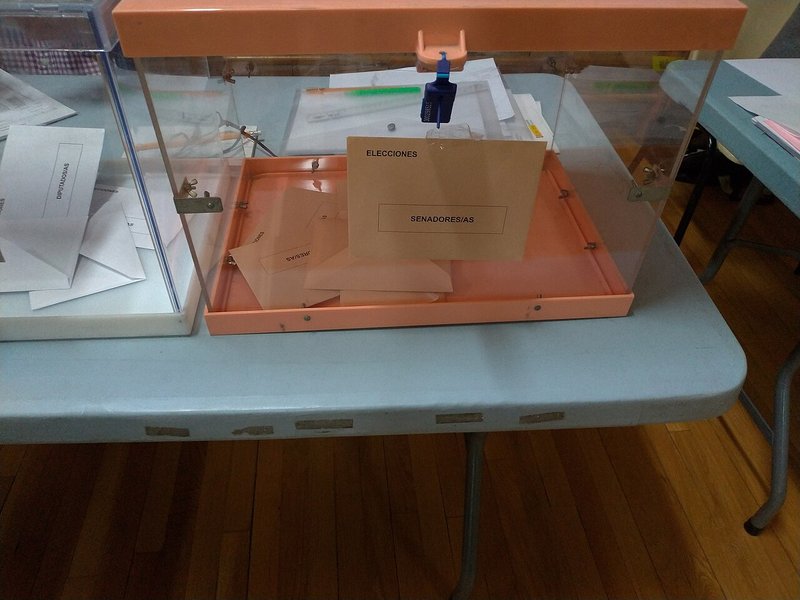
This image is believed to be available for open use. Credit: Laura Hale / Wikimedia Commons. If you are the rights holder and object, contact us and we'll remove it.
The Congress of Deputies being replaced was elected on July 23, 2023. The official results published by the Junta Electoral Central in the Official State Gazette on Sept. 1, 2023, and later corrected, allocated the 350 seats as follows: People's Party 137; Spanish Socialist Workers' Party 102 and the Socialists' Party of Catalonia 19, together 121; Vox 33; Sumar 31; Republican Left of Catalonia 7; Junts 7; EH Bildu 6; Basque Nationalist Party 5; Galician Nationalist Bloc 1; Canarian Coalition 1; and Navarrese People's Union 1.
| Party or list, as published by the Junta Electoral Central for the July 23, 2023, election | Seats in the Congress of Deputies |
|---|---|
| People's Party (PP) | 137 |
| Spanish Socialist Workers' Party (PSOE) | 102 |
| Socialists' Party of Catalonia (PSC-PSOE) | 19 |
| PSOE and PSC together | 121 |
| Vox | 33 |
| Sumar | 31 |
| Republican Left of Catalonia (ERC) | 7 |
| Junts | 7 |
| EH Bildu | 6 |
| Basque Nationalist Party (EAJ-PNV) | 5 |
| Galician Nationalist Bloc (BNG) | 1 |
| Canarian Coalition (CCa) | 1 |
| Navarrese People's Union (UPN) | 1 |
| Total | 350 |
Table: GROKsiNEWS.com. Source: Junta Electoral Central official results of the July 23, 2023, general election, published in the Official State Gazette, resolution of Aug. 30, 2023 (BOE-A-2023-18907). The chambers elected then were dissolved on Oct. 6, 2026, by Royal Decree 806/2026. Mid-term changes in group membership after 2023 are not included.
Sources
- Official State Gazette, Royal Decree 806/2026 of Oct. 5, 2026, dissolving the Congress of Deputies and the Senate and calling elections, published Oct. 6, 2026, BOE-A-2026-20742
- Official State Gazette, Junta Electoral Central, resolution of Aug. 30, 2023, publishing the results of the July 23, 2023, general election, BOE-A-2023-18907
- Centro de Investigaciones Sociológicas, study 3584, "Preelectoral elecciones generales 2026," avance de resultados, fieldwork Oct. 7–30, 2026, released Nov. 12, 2026, including the national vote estimate
- CIS announcement page for the same avance
- Reuters, Emma Pinedo, Mireia Merino and Victoria Waldersee, writing by Andrei Khalip, edited by Alexandra Hudson and Alex Richardson, "Spain general election 2026: polls, Sanchez vs Feijoo and what happens next," Nov. 26, 2026, 4:00 p.m. UTC (11 a.m. ET), updated later
- BBC News, Nick Beake, "Leaders clash in final Spain election debate as housing dominates run-in," Friday, Nov. 27, 2026
- BBC News, Paul Kirby, Phoebe Hopson and Laura Gozzi, "Spanish elections: What you need to know and what's at stake," Thursday, Nov. 26, 2026
- Al Jazeera, Hanna Duggal and Mohamed Hussein, "Spain's 2026 election explained in maps and charts," Nov. 27, 2026
- Congress of Deputies, page on the dissolution and the calling of elections
- GROKsiNEWS.com, prior coverage of the Nov. 11 housing general strike
- Wikimedia Commons, Antonio.velez, Palacio de las Cortes facade, Feb. 8, 2009
- Wikimedia Commons upload file, same photograph
- Wikimedia Commons, Luis García, Skyline Madrid residential towers, Sept. 23, 2022
- Wikimedia Commons upload file, same photograph
- Wikimedia Commons, Laura Hale, Senate ballot box, Madrid, April 28, 2019
- Wikimedia Commons upload file, same photograph