Virginia court voids one felon-in-possession conviction
The Supreme Court of Virginia said the state's felon-in-possession law violated the Second Amendment as applied to one man, in what it called a narrow ruling.
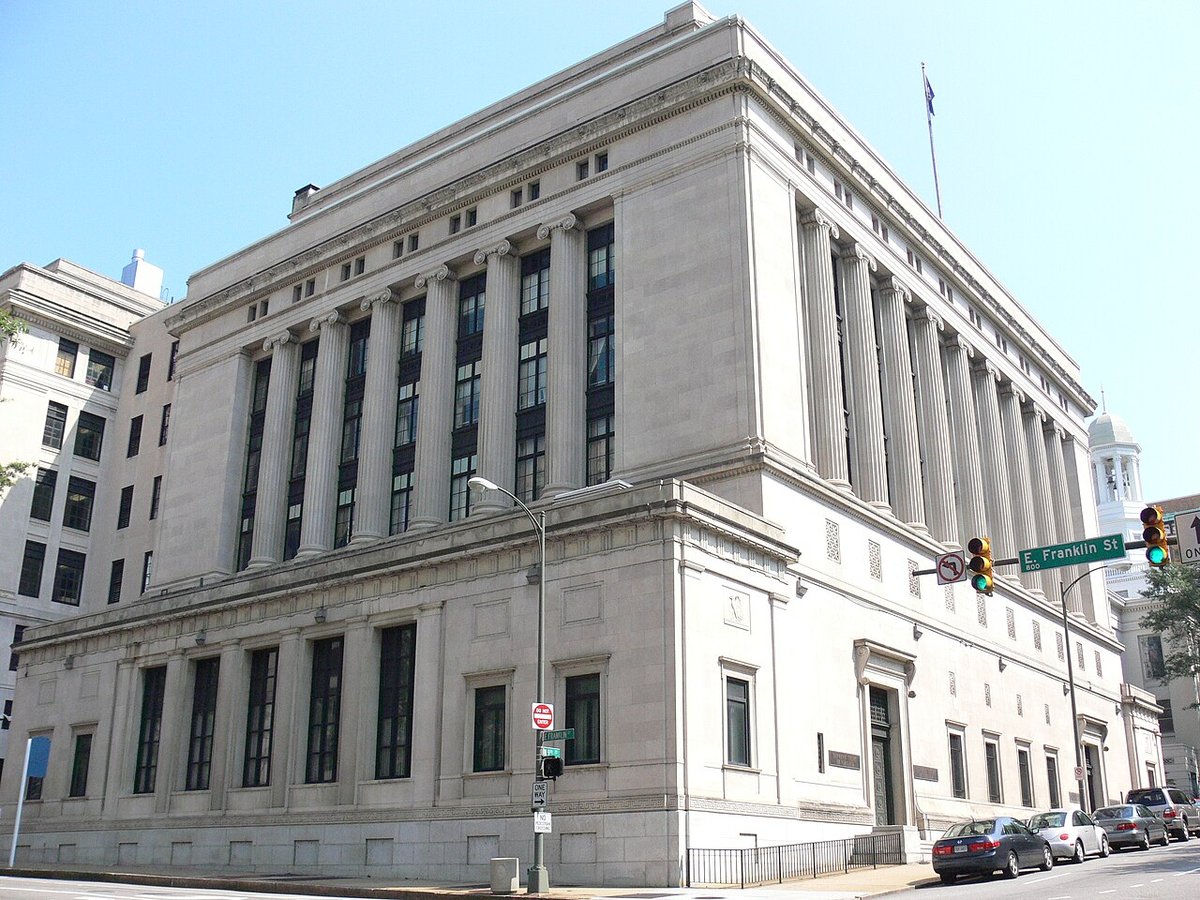
This image is believed to be available for open use. Credit: Morgan Riley / Wikimedia Commons. If you are the rights holder and object, contact us and we'll remove it.
As of 11:39 a.m. ET, Friday, Nov. 27, 2026
The Supreme Court of Virginia on Wednesday, Nov. 25, 2026, reversed a Court of Appeals decision and vacated Derek Wade Ginevan's conviction for possessing a firearm after having been convicted of a felony, holding that Code § 18.2-308.2 violated the Second Amendment as applied to him on the record before the court.
Justice Wesley G. Russell Jr. wrote the opinion in Ginevan v. Commonwealth, Record No. 250051. The court was composed of Chief Justice Powell and Justices Kelsey, McCullough, Chafin, Russell, and Mann, and Senior Justice Millette. No separate dissenting or concurring opinion was filed. Courthouse News Service also described the ruling as unanimous.
The opinion recites that on Jan. 24, 2023, police responded to a possible domestic disturbance, encountered Ginevan in a dispute with a woman, and that the woman claimed he had grabbed a shotgun and pointed it at her. Ginevan admitted possessing the shotgun but denied pointing it at her, the court said, and told police he had it for protection. After he confirmed that he was a convicted felon, he was arrested and charged with possessing a firearm as a convicted felon. In a footnote, the court said that although there was evidence he "may have pointed his shotgun at someone, he was neither charged with nor convicted for any use of the shotgun" and was charged "only with mere possession."
Ginevan moved to dismiss the indictment, arguing that the statute was unconstitutional as applied to him. After the trial court denied the motion, he entered a conditional guilty plea, preserving the Second Amendment question for appeal, the opinion said. The court noted that he had been indicted for possessing a firearm after previously having been convicted of a violent felony, and that, as a result of the plea, the charge was amended to possession of a firearm by a felon within 10 years of a prior felony conviction.

This image is believed to be available for open use. Credit: Martin Falbisoner / Wikimedia Commons. If you are the rights holder and object, contact us and we'll remove it.
The Court of Appeals had affirmed the conviction. The Supreme Court of Virginia agreed with Ginevan and reversed. "The fact that the phrase 'right of the people' means the same thing in the First, Fourth, and Second Amendments is, by our reckoning, sufficient to resolve whether a felony conviction, without more, removes a person from the political community," the opinion said. "Because a felony conviction does not remove a person from 'the people' referenced in the First and Fourth Amendments, we conclude that, as a matter of language and logic, it does not remove a person from 'the people' referenced in the Second Amendment."
The court then applied the framework set out by the U.S. Supreme Court in New York State Rifle & Pistol Ass'n v. Bruen, 597 U.S. 1 (2022), and United States v. Rahimi, 602 U.S. 680 (2024). Once the conduct falls within the Second Amendment's plain text, the court said, it is the Commonwealth's burden to show that the regulation is consistent with the nation's historical tradition of firearm regulation.
The opinion reviews Ginevan's prior felony convictions as they appear in the record: a 2011 conviction for possession with intent to distribute a Schedule I/II controlled substance; three later felony probation-violation convictions; and 2018 convictions for obtaining money by false pretenses and for possession of ammunition by a convicted felon. "Notably, pursuant to Code § 17.1-805(C), the General Assembly has classified possession of ammunition by a convicted felon as a violent felony, but none of Ginevan's other felony convictions are so classified," the court said. It also said that, apart from documents identifying the convictions by name, "nothing in the record properly before us establishes that any act of actual violence was associated with the actions that led to Ginevan's felony convictions."
To justify permanent disarmament on this record, the court said, the Commonwealth "needed to demonstrate that at least one of his prior convictions represented a finding 'by a court'" that Ginevan posed "a credible threat to the physical safety of another," quoting Rahimi. "The absence of such evidence means the Commonwealth failed to carry its burden." The court also said that statutes banning convicted felons from possessing firearms as a result of their prior felony convictions "are a creature of twentieth century legislatures," and that the Commonwealth did not "point to any American statute that, based solely on a prior felony conviction, expressly banned even violent felons from possessing firearms before the 1920s."

This image is believed to be available for open use. Credit: Bdl2001 / Wikimedia Commons. If you are the rights holder and object, contact us and we'll remove it.
"We emphasize that our decision today 'is a narrow one,'" the court said, quoting the U.S. Supreme Court in Hemani. "We only hold that a felony conviction alone does not remove one from 'the people' protected by the Second Amendment and that, on the record properly before us, the Commonwealth failed to carry its burden to establish that Code § 18.2-308.2's permanent disarmament of Ginevan was sufficiently 'consistent with the Nation's historical tradition of firearm regulation,'" citing Bruen, "to survive his Second Amendment challenge." The court added: "A case dealing with different offenses, a defendant with a different criminal history, or a different evidentiary record may well lead to a different conclusion."
The court reversed the judgment of the Court of Appeals, vacated Ginevan's conviction for violating Code § 18.2-308.2, and entered final judgment for him on that count. In a footnote, it said he had also pleaded guilty to misdemeanor destruction of property in violation of Code § 18.2-137, adding: "Nothing in our decision today affects that conviction."
The opinion discusses U.S. Supreme Court cases that declined to decide the federal felon-in-possession statute, 18 U.S.C. § 922(g)(1), because that statute was not before those courts. It does not itself decide the validity of the federal statute. Courthouse News Service reported that the ruling "doesn't change the fact federal law prohibits felons from purchasing firearms." Courthouse News also reported that the Office of Attorney General Jay Jones did not respond to a request for comment. No statement on the ruling was found on the attorney general's website at the time of writing.
GROKsiNEWS.com previously reported on a related federal felon-in-possession decision from the 10th U.S. Circuit Court of Appeals.
| Conviction, as the opinion describes it | Year given in the opinion | Classified as a violent felony under Code § 17.1-805(C), as the opinion states it |
|---|---|---|
| Possession with intent to distribute a Schedule I/II controlled substance | 2011 | No. The opinion says none of Ginevan's felony convictions other than the ammunition offense are so classified. |
| Felony probation violations (three convictions) | Over the four years after 2011 | No. Same statement by the court. |
| Obtaining money by false pretenses | 2018 | No. Same statement by the court. |
| Possession of ammunition by a convicted felon | 2018 | Yes. The court says the General Assembly has classified this offense as a violent felony under Code § 17.1-805(C). |
| Record on "actual violence" | Not a separate conviction | The court said the record before it does not establish that any act of actual violence was associated with the actions that led to the felony convictions, and that the ammunition conviction did not require a judicial finding that he posed a credible threat to the physical safety of another. |
Table: GROKsiNEWS.com. Source: Supreme Court of Virginia, Ginevan v. Commonwealth, Record No. 250051, Nov. 25, 2026.
Sources
- Supreme Court of Virginia, Ginevan v. Commonwealth, Record No. 250051, opinion by Justice Wesley G. Russell Jr., Nov. 25, 2026 (PDF)
- Courthouse News Service, Joe Dodson, "Virginia Supreme Court rules state unconstitutionally disarmed nonviolent felon," Nov. 25, 2026
- Reason, Eugene Volokh, "Virginia S. Ct.: Felons Who Served Their Sentences Regain Second Amendment Rights Unless …," Nov. 25, 2026
- GROKsiNEWS.com, earlier coverage of a related federal decision
- Wikimedia Commons, SupremeCourtofVirginiaBuilding.JPG
- Wikimedia Commons, Virginia State Capitol late morning.JPG
- Wikimedia Commons, Richmond, Virginia Skyline March 2025.jpg