ESA's Hera finds stadium-sized crater on Dimorphos
The European Space Agency said on Wednesday, Nov. 25, 2026, that its Hera spacecraft has found that Dimorphos, the small asteroid whose orbit was deflected by NASA's DART spacecraft in 2022, now has one face flattened with a stadium-sized crater and is tumbling chaotically, while hundreds of previously unknown boulders encircle the binary pair.
© ESA. Used for editorial and informational purposes under ESA's terms for images and videos. If you are the rights holder and object, contact us and we'll remove it.
As of 2:29 p.m. ET, Wednesday, Nov. 25, 2026
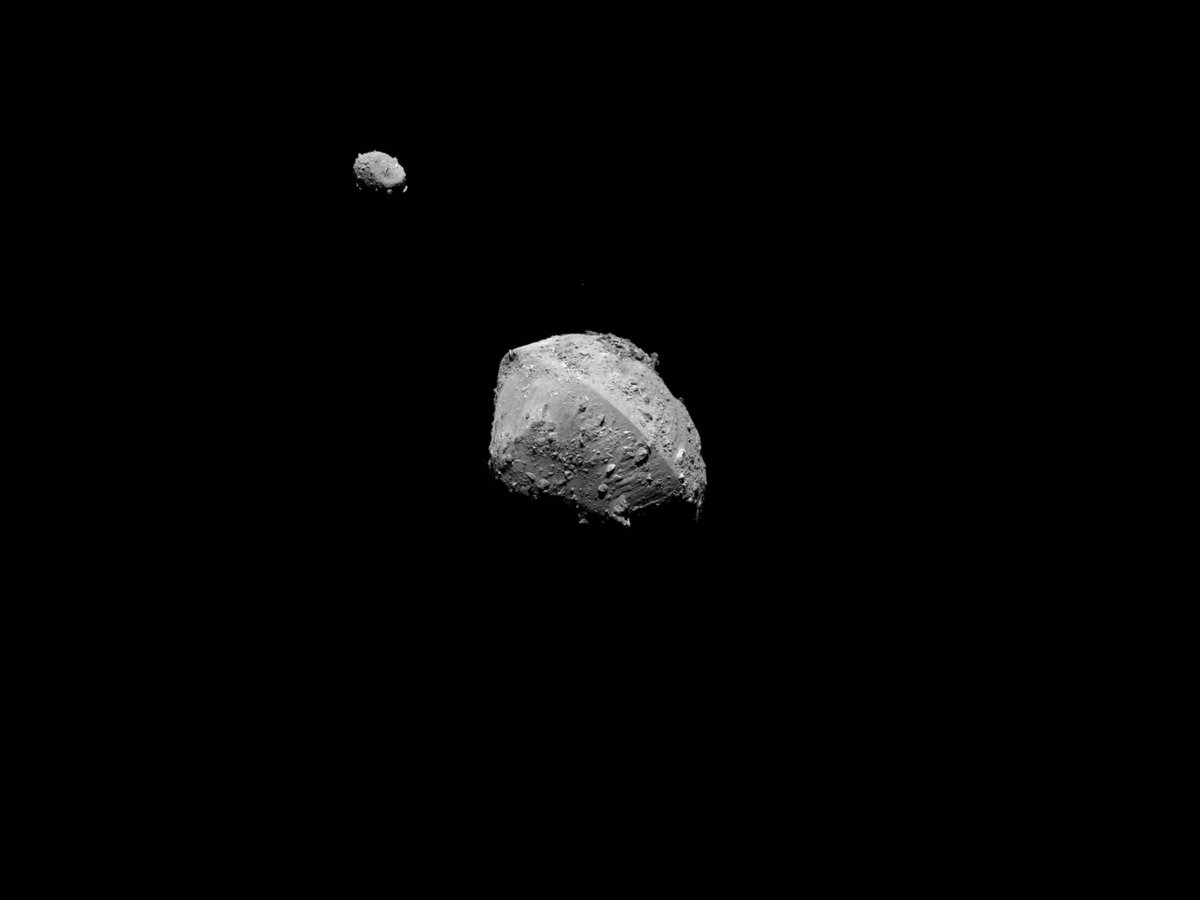
The European Space Agency's Hera mission has found "a miniature world of surprises" at the site of humankind's first planetary defence experiment, the agency said on Wednesday, Nov. 25, 2026, as it unveiled the first images of Dimorphos from the spacecraft.
Dimorphos, "the small asteroid whose orbit around a second larger asteroid was deflected by a spacecraft impact," now has one face flattened with a stadium-sized crater and is tumbling chaotically, ESA said. Hundreds of previously unknown boulders encircle the binary pair, the agency said.
The 151-meter-diameter Dimorphos moonlet orbits the 730-meter-diameter Didymos asteroid, ESA said. The pair is in orbit around the Sun and is currently 193.5 million kilometers from Earth, according to the agency.
On Sept. 26, 2022, NASA's DART spacecraft deliberately impacted Dimorphos, "shortening its orbit by a much greater than predicted 33 minutes," ESA said. Telescopes on Earth measured the orbit change, the agency said, but one fundamental question remained unanswered: what had actually happened to Dimorphos?
"Scientists debated whether Dimorphos had sustained an impact crater, changed its shape or stayed the same," said Hera principal investigator Patrick Michel, director of research at CNRS / Observatoire de la Côte d'Azur. "Much to our surprise the answer turns out to be all three at once! The face struck by DART has been flattened into an impact crater the size of a sports stadium, which extends across the asteroid's entire width."
The rest of Dimorphos does not show evidence of major changes, and the boulder fields covering its other regions look just like they did in DART's 2022 images, ESA said.
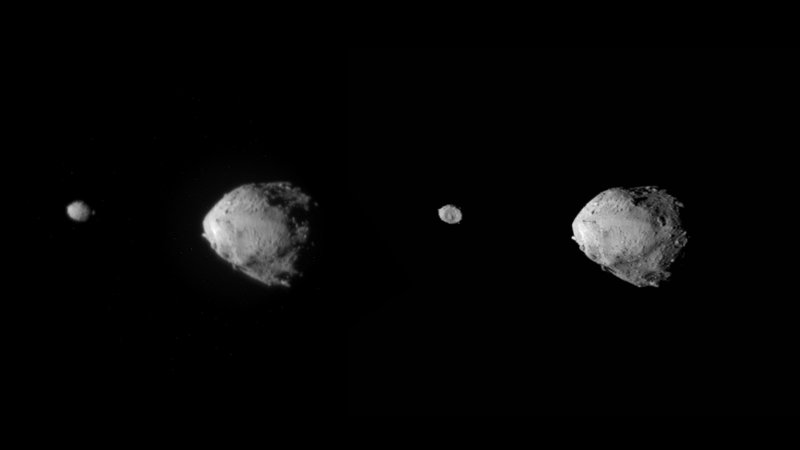
© Left, NASA/Johns Hopkins APL; right, ESA. Used for editorial and informational purposes under ESA's terms for images and videos. If you are the rights holder and object, contact us and we'll remove it.
"In addition, as Hera returned more images, it became clear that the DART impact has left Dimorphos tumbling wildly in its orbit," said Michael Kueppers, ESA's Hera mission scientist.
"Another big surprise is that Hera is showing that the asteroids are surrounded by hundreds of orbiting boulders, just a few metres in size," Kueppers said. "The team will have to take account of these objects in the coming weeks as the mission moves in closer to acquire higher-resolution images of the asteroids."
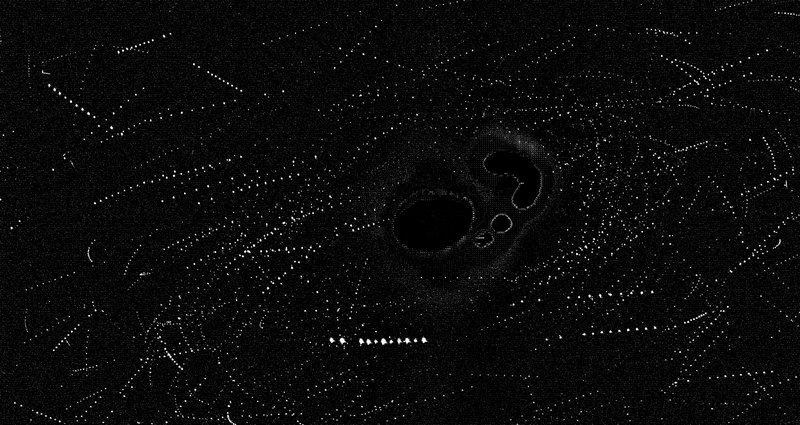
© ESA. Used for editorial and informational purposes under ESA's terms for images and videos. If you are the rights holder and object, contact us and we'll remove it.
Ian Carnelli, Hera mission manager, unveiled the first images of Dimorphos from the dinosaur hall of the Museum für Naturkunde Berlin, ESA said. "Sixty-six million years ago, an asteroid impact changed the course of life on Earth. Today, for the first time in history, humanity is validating how to prevent such an event from happening again," Carnelli said. "NASA's DART mission demonstrated that we can change an asteroid's orbit. Hera is now revealing what happened to the asteroid itself. By combining these two missions, humanity is taking a decisive step towards making asteroid deflection a reliable tool for protecting our planet."
These first images mark the beginning, rather than the conclusion, of Hera's investigation, ESA said.
The small-car-sized Hera spacecraft has been observing during its "early characterisation phase" using a trio of instruments: the monochrome Asteroid Framing Camera, the multispectral Hyperscout H, which observes in 25 separate colors at once, and the Japan Aerospace Exploration Agency's Thermal Infrared Imager, TIRI, which measures surface temperatures, ESA said.
The spacecraft is currently flying about 25 to 30 kilometers from Didymos and Dimorphos, using its thrusters to maintain "rectangular orbits" around the two ultra-low-gravity bodies at an average velocity of just 12 centimeters per second, the agency said.
In December, the spacecraft is scheduled to approach to around 13 kilometers from the asteroid pair, returning progressively higher-resolution images, ESA said. In January 2027, Hera plans to deploy two shoebox-sized CubeSats, Juventas and Milani, that will venture closer still. Operating together, Hera, Juventas and Milani will form a three-spacecraft exploration system around the two asteroids, the agency said.
| Fact | ESA figure |
|---|---|
| Dimorphos diameter | 151 meters |
| Didymos diameter | 730 meters |
| Distance from Earth, as ESA stated | 193.5 million kilometers |
| DART impact date | Sept. 26, 2022 |
| Change in Dimorphos orbit | Shortened by a much greater than predicted 33 minutes |
| Hera current distance from the pair | About 25 to 30 kilometers |
| Average velocity in "rectangular orbits" | 12 centimeters per second |
| Next planned approach | Around 13 kilometers, in December |
| CubeSat deployment (Juventas and Milani) | January 2027 |
Table: GROKsiNEWS.com. All figures are ESA's, from its Nov. 25, 2026, article and image captions.
ESA Director-General Josef Aschbacher said the work was "international collaboration at its best: NASA having demonstrated that an asteroid can be deflected, ESA is now providing the detailed scientific investigation needed to understand how that deflection worked, along with valuable contributions from international partners, including Japan's JAXA."
Hera and its CubeSats were manufactured by a consortium of 18 ESA member states, led by OHB in Germany, the agency said. ESA said Hera is its first planetary defence mission and that it is also developing Ramses, in cooperation with JAXA, to investigate the asteroid Apophis during its close but "entirely safe" Earth flyby on Friday, April 13, 2029, when, ESA said, Apophis will pass approximately 32,000 kilometers above Earth's surface.
Sources
- European Space Agency, "Hera reveals stadium-sized asteroid crater from spacecraft impact," esa.int, Nov. 25, 2026
- ESA media pages and captions, Nov. 25, 2026 ; https://www.esa.int/media/pre-and-post-dart-impact-comparison-of-the-didymos-system ; https://www.esa.int/media/long-exposure-hyperscout-h-image-reveals-boulders
- Rebecca Morelle, Alison Francis and Tony Jolliffe, "Images of asteroid targeted to test Earth's defences reveal stadium-sized crater," BBC News, Nov. 25, 2026 (context)
- Jeremy Wilks, "ESA releases first images showing 'complete chaos' on asteroid smashed by NASA probe," Euronews, Nov. 25, 2026 (context)
- Michael Banks, "Close-up images reveal giant DART impact crater on asteroid Dimorphos," Physics World, Nov. 25, 2026 (context)