NASA locks in design of SR-1 Freedom nuclear Mars spacecraft
NASA said on Tuesday, Nov. 24, 2026, that a major design review at its Glenn Research Center had locked in key elements of Space Reactor-1 Freedom, which is planned to launch in late 2028 and carry the SkyFall capsule with three helicopters to Mars.
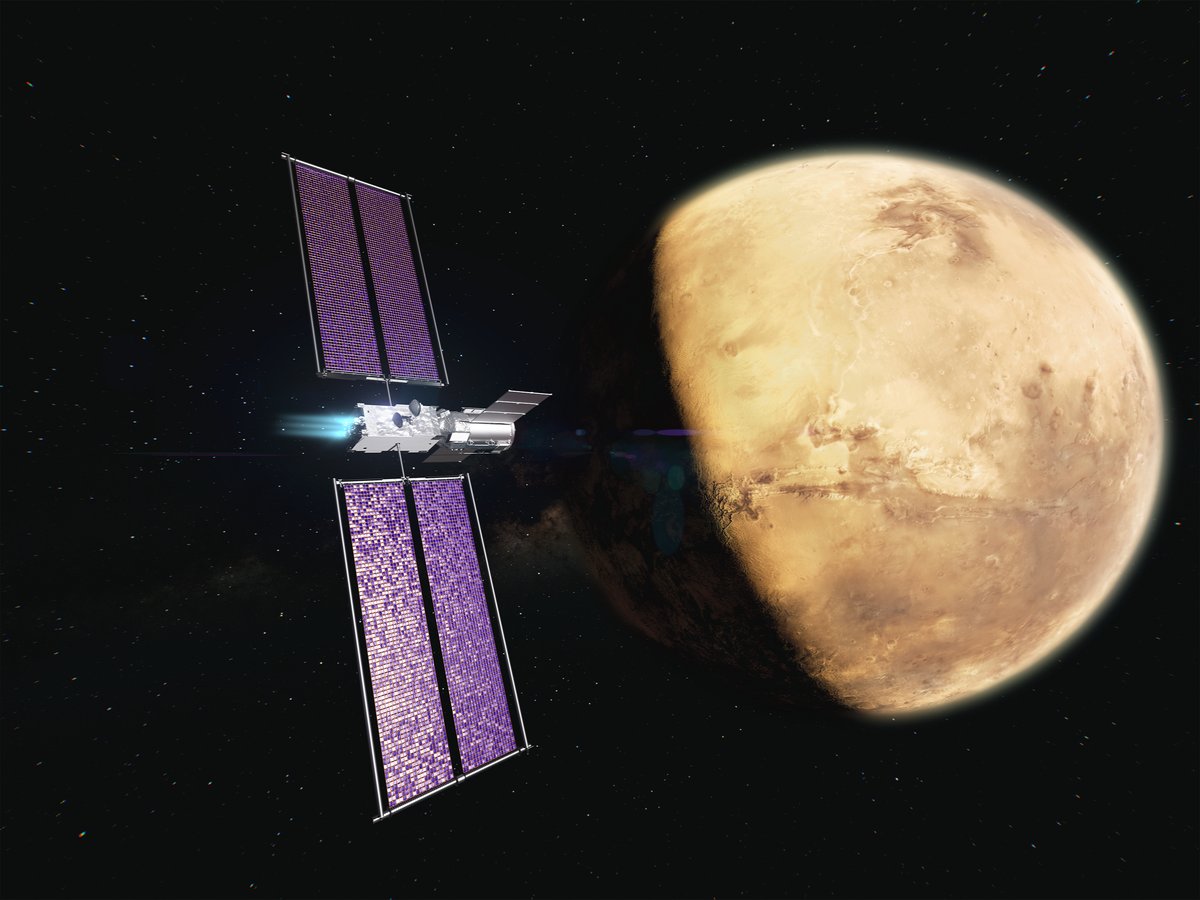
This image is believed to be available for open use. Credit: NASA/Jonathan North. If you are the rights holder and object, contact us and we'll remove it.
As of 8:25 a.m. ET, Wednesday, Nov. 25, 2026
NASA has completed a major review of Space Reactor-1 (SR-1) Freedom and locked in key elements of the spacecraft, which is targeted to launch in 2028 and demonstrate nuclear electric propulsion in deep space for the first time, the agency said on Tuesday, Nov. 24, 2026.
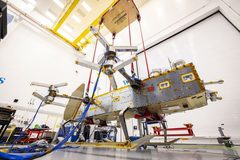
Experts from NASA, the U.S. Department of Energy and industry met at NASA's Glenn Research Center in Cleveland for the mission design review in October, NASA said.
"Planned for launch in late 2028, SR-1 will use both nuclear and solar power to deliver SkyFall, a capsule carrying three next-generation helicopters, to Mars," the agency said. Once deployed, the helicopters will study Martian geology and climate history, explore new terrain and search for signs of subsurface ice, according to NASA.
| Feature | NASA figure |
|---|---|
| Launch target | Late 2028 |
| Weight | About 26,455 pounds (12,000 kilograms) |
| Reactor fuel | High-Assay Low-Enriched Uranium (HALEU) |
| Nuclear power | 20 kilowatts electric, closed Brayton cycle power conversion |
| Spacecraft bus | Power and Propulsion Element generating 48 kilowatts of electrical power |
| Thrusters | Advanced Electric Propulsion System, 12-kilowatt Hall thruster |
| Communications | X-band with NASA's Deep Space Network |
| Payload | SkyFall capsule with three Mars helicopters |
| Heat rejection contract | $39.3 million to Johns Hopkins APL |
Source: NASA, SR-1 Freedom mission page and Nov. 24, 2026, release. Some design features, including reactor power output levels, are still being evaluated, NASA said. Table: GROKsiNEWS.com.
"This mission will be the first freight run on the railroad of the solar system, and the decisions we're making now are laying the tracks for every nuclear-powered spacecraft that follows," said Steve Sinacore, SR-1 Freedom program director.
One significant change is a shorter boom than the one shown in early illustrations, NASA said. The boom separates the reactor from the spacecraft's main body, known as the Power and Propulsion Element; the shorter boom will reduce weight, simplify assembly and help streamline the design. NASA and DOE experts also determined that improved shielding and spacecraft design will allow the reactor to operate closer to the rest of the spacecraft.
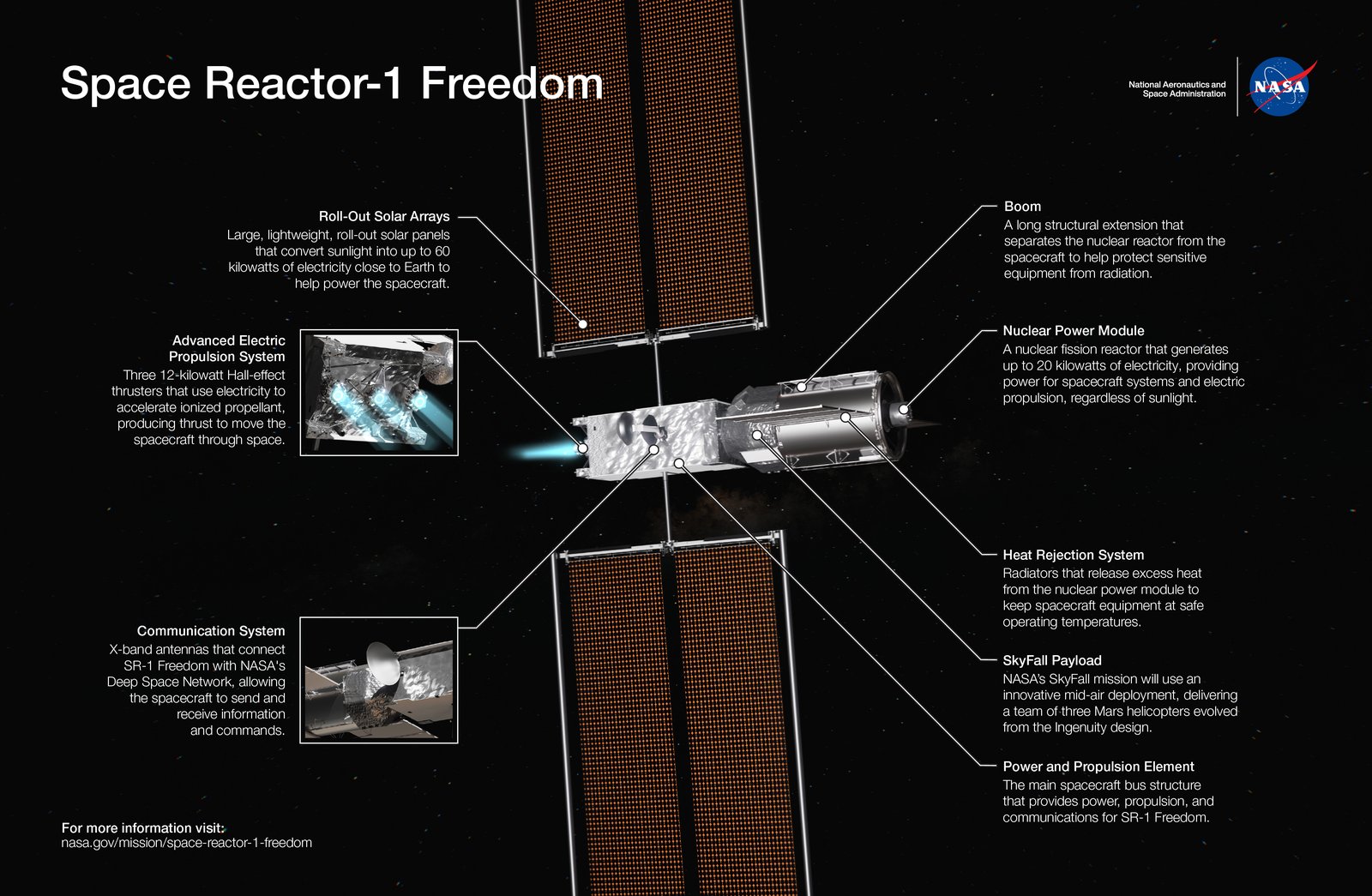
This image is believed to be available for open use. Credit: NASA/David Lam. If you are the rights holder and object, contact us and we'll remove it.
Teams are still evaluating other features, including the number of radiator panels, the output power levels of the nuclear power module and how long the reactor will operate, the agency said. SR-1 Freedom will also use larger X-band antenna dishes to send data back to Earth.
NASA said it awarded a $39.3 million contract to Johns Hopkins University's Applied Physics Laboratory to develop the heat rejection system for the spacecraft's nuclear power module, working with Advanced Cooling Technologies.
Under the updated mission profile, SR-1 Freedom will activate and gradually increase reactor power after leaving Earth orbit, operate the reactor for an initial period, then shut it down and cruise to Mars on solar power, NASA said. After delivering SkyFall to Martian orbit, the spacecraft will restart its reactor to collect more performance data.
Sources
- NASA (Jacqueline Minerd), "Teams Lock in Mission Architecture for NASA's SR-1 Freedom," nasa.gov, Nov. 24, 2026
- NASA, "Space Reactor-1 Freedom" mission page (specifications)