NASA's Titan-bound Dragonfly gets its seven science cameras
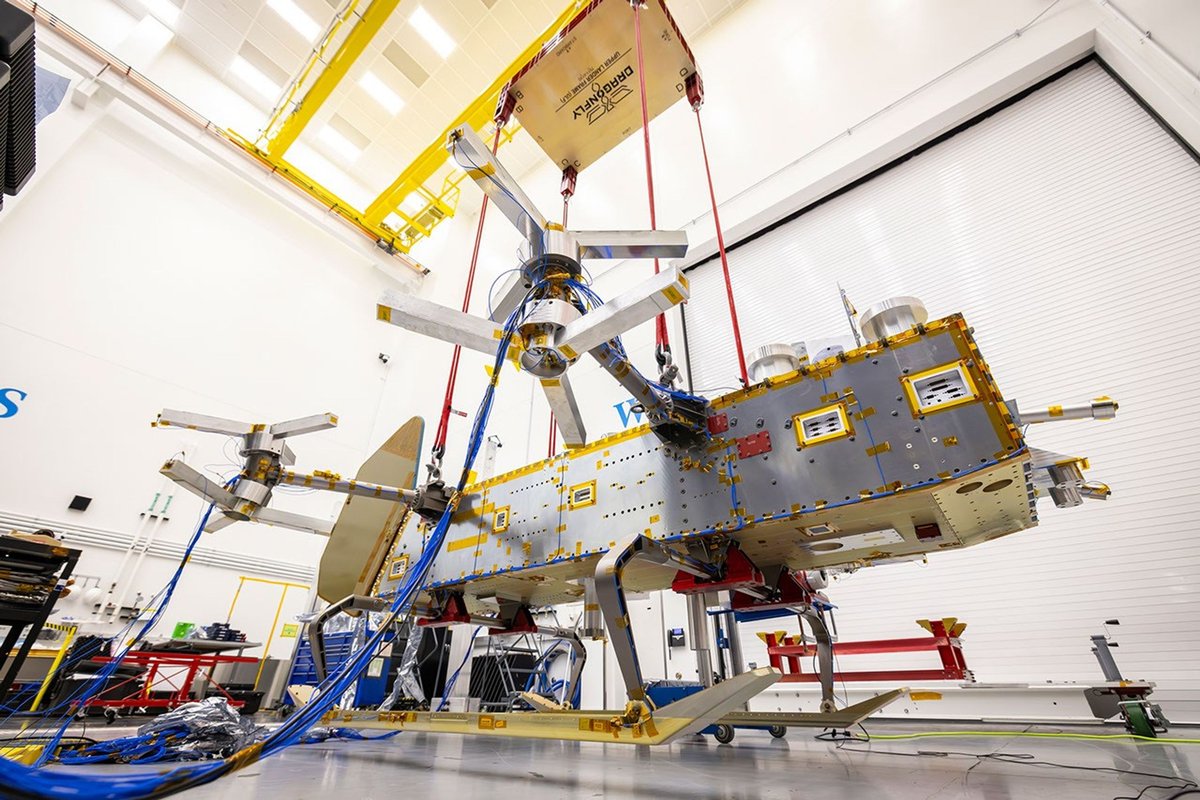
All seven cameras of DragonCam, the science imaging suite for NASA's Dragonfly rotorcraft, have been installed, tested and integrated into the vehicle at the Johns Hopkins Applied Physics Laboratory, NASA said on Tuesday, Nov. 24, 2026. Dragonfly is scheduled to launch in July 2028 and reach Titan in late 2034.
This image is believed to be available for open use. Credit: NASA/Johns Hopkins APL/Ed Whitman. If you are the rights holder and object, contact us and we'll remove it.
As of 4:56 p.m. ET, Tuesday, Nov. 24, 2026
All seven cameras in DragonCam, the science imaging suite for NASA's Dragonfly rotorcraft, have been installed on the vehicle, NASA said on Tuesday, Nov. 24, 2026.
"By mid-November, all seven cameras developed and built by Malin Space Science Systems had been installed in their insulated housings, tested, and integrated into the rotorcraft," NASA said. The car-sized rotorcraft is being assembled at the Johns Hopkins Applied Physics Laboratory (APL) in Laurel, Maryland, for its mission to Saturn's largest moon, Titan. NASA said DragonCam is the first of Dragonfly's science instruments to arrive.
Each camera will look out through a window in a foam enclosure that insulates the cameras and Dragonfly's interior from Titan's cryogenic environment, where NASA said ambient temperatures reach minus 290 degrees Fahrenheit.
According to NASA, two forward-facing cameras, a wide-angle camera with a 90-degree field of view and a medium-angle camera, together give a stereoscopic view of the terrain ahead. Two side-mounted wide-angle cameras help capture panoramas. Two downward-facing wide-angle cameras will help the team decide whether a landing spot is safe for the sampling drill, called DrACO, and the seismometer. A high-resolution microscopic imager will aim at the drill site to pick out details in millimeter-sized sand grains.
An LED array built at APL, spanning the infrared to the ultraviolet, will help scientists infer the composition of surface materials. NASA said that during Titan's long night, nearly eight Earth days, the ultraviolet light may also allow DragonCam to identify organic molecules that fluoresce.
"With the capability to take images when Dragonfly is on the surface as well as while flying, DragonCam will give us both detailed views and sweeping panoramas of Titan's landscape," said Elizabeth Turtle, Dragonfly principal investigator at APL.
"DragonCam will give us critical context for the samples collected by DrACO," said Carolyn Ernst, the DragonCam instrument scientist at APL.
NASA said Dragonfly's other instrument packages, DraGNS, DraGMet and DraMS, as well as DrACO, are set for delivery, integration and testing over the next several months. Two navigation cameras, also built by Malin Space Science Systems, were installed this summer.
"Dragonfly is scheduled to launch in July 2028 and reach Titan in late 2034," NASA said.
Sources
- NASA Science Editorial Team, "NASA's Titan-Bound Dragonfly Rotorcraft Gets Its Eyes," science.nasa.gov, Nov. 24, 2026, 10:44 a.m. ET (, read in full; every fact, figure and quote comes from this page)