Voyager 1 reaches one light-day from Earth, NASA says
NASA said Voyager 1 reached one light-day from Earth — about 16.1 billion miles — at 5:16 a.m. ET on Wednesday, Nov. 18, and that flight controllers received its radio signal 24 hours later, early Thursday. The Associated Press reported that the signal took exactly 24 hours to cross more than 16 billion miles. NASA said no science or engineering data have been received since Nov. 14, but a carrier signal was used to confirm the milestone.
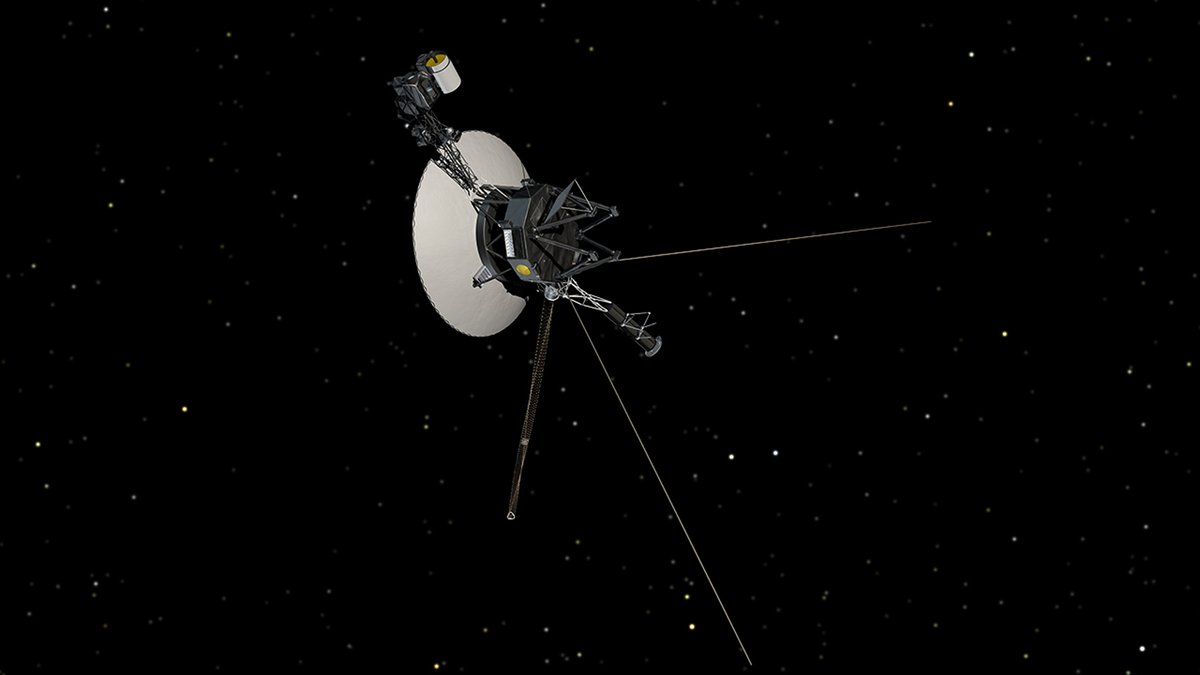
This image is believed to be available for open use. Credit: NASA/JPL-Caltech. If you are the rights holder and object, contact us and we'll remove it.
As of 12:55 p.m. ET, Thursday, Nov. 19, 2026
NASA's Voyager 1 probe reached one light-day from Earth at 2:16 a.m. PST (5:16 a.m. ET) on Wednesday, Nov. 18, 2026, after more than 49 years of travel, NASA said in a news release Thursday. A light-day is the distance light travels in 24 hours, equal to about 16.1 billion miles (25.9 billion kilometers), the space agency said.
Voyager team members at NASA's Jet Propulsion Laboratory in Southern California heard from the probe 24 hours later, the time it took for the spacecraft's radio signal, traveling at the speed of light, to reach Earth, early Thursday, NASA said. Flight controllers received the spacecraft's call Thursday, exactly 24 hours after it was sent, crossing more than 16 billion miles (26 billion kilometers), the Associated Press reported.
"Traveling a light-day is a singular feat for a spacecraft, but Voyager is so much more than a distant traveler," said Joe Westlake, director of the Heliophysics Division at NASA Headquarters, in the agency's release. The Associated Press also quoted the statement.
The team has not received science or engineering data from Voyager 1 since Nov. 14, but the spacecraft is sending a carrier signal that typically conveys that data to Earth, NASA said. Mission engineers used the carrier signal and trajectory calculations to confirm the light-day milestone and continue to analyze the issue affecting the data, according to the release. AP also reported that no science or engineering data have been received since Saturday and that the carrier signal, with flight-path calculations, allowed the team to confirm the milestone.
Voyager 1 launched in 1977 and in 2012 became the first spacecraft to enter interstellar space, NASA said. It is traveling about 38,000 mph (61,155 kph), according to the release. Its twin, Voyager 2, entered interstellar space in 2018 and will not reach the one-light-day mark until 2035, AP reported.
"Voyager 1 crossing the light-day threshold is yet another historic feat on an extraordinary voyage of discovery," JPL Director Dave Gallagher said in the NASA release.
Sources
- NASA, Jessica Taveau, "NASA's Voyager 1 Makes History Reaching One Light-Day From Earth," Nov. 19, 2026
- Associated Press, Marcia Dunn, "NASA's Voyager 1 phones home from an awe-inspiring one light-day away," Nov. 19, 2026, via The Seattle Times